The Robot's Full Bill
A robot's purchase price is only part of its economics. The useful unit is an accepted physical outcome, with integration and recovery included.
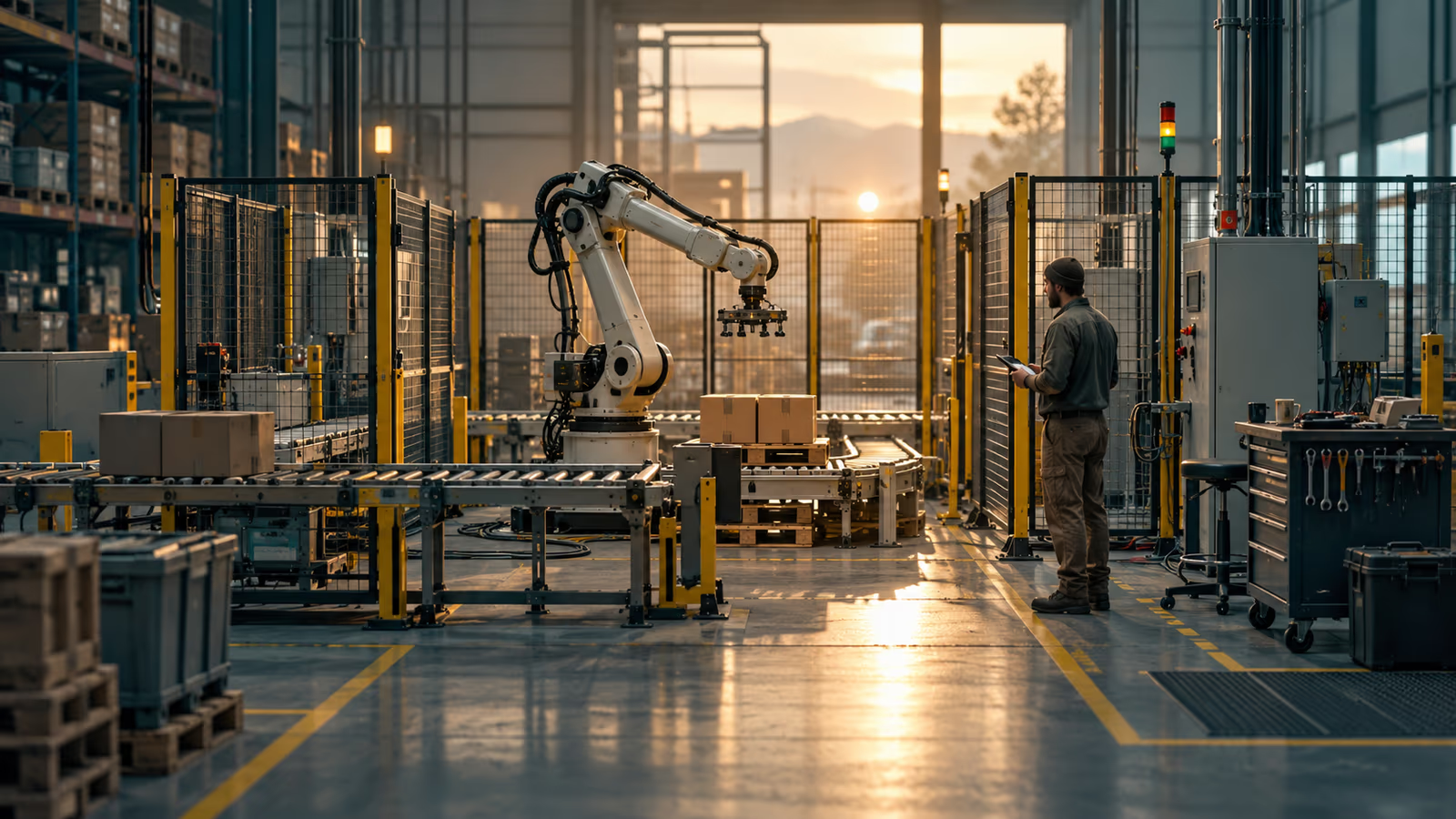
A robot can perform a task and still be a poor investment for the place where the task needs doing.
The surrounding operation has to accommodate it. Someone installs it, connects it to the workflow, maintains it, and responds when an ordinary variation stops the work. Those requirements belong in the economic argument from the beginning.
This is not a reason to dismiss robotics. It is a reason to evaluate the complete deployment. The relevant comparison is the cost and quality of an accepted physical outcome under realistic conditions, including the work required to recover from failure.
The companies that make robotics broadly useful will improve that whole equation. A cheaper machine is one route. A more reliable handoff or a better-designed environment can be another.
Capability does not settle the economic case
Anthropic's September 30 study, What work can robots do?, estimates that robots can perform 74% of physical tasks when weighted by working time and employment, largely in constrained settings. That corresponds to 34% of all working hours. Its estimate of currently cost-competitive work is much smaller: 0.3% of work overall.
Those figures have different denominators and should not be read as a direct conversion rate. They also come from a model-assisted analysis of task descriptions, capability evidence, and costs, rather than an audited census of workplace deployments.
The study's roughly forty-year scenario for reaching 10% cost-competitive work assumes historical price declines continue. It is conditional, not a date on which robotics is scheduled to arrive. Faster technical or commercial progress could change it substantially.
For an operator, the useful implication is narrower. Evidence that a robot can perform a task leaves the site-specific business case to be established.
That remains true whether the broad estimates turn out to be too optimistic or too conservative. A plant manager has to understand the actual work, the available alternatives, and the consequences of interruption at that plant.
Start with the workcell, then the machine
Consider a hypothetical warehouse step: moving a container from one conveyor to another.
The nominal action is easy to describe. The production workflow contains more variation. Containers arrive misaligned. Labels become unreadable. The receiving conveyor pauses. A damaged item needs somewhere to go.
A complete design gives those events a path. It defines when the robot retries, when it stops, who responds, and how the rest of the operation continues. It also records whether the item reached the correct destination.
This work can be done well. It should be priced honestly.
A low intervention rate may still require expensive support if interventions are unpredictable or if response time matters. Conversely, a modest robot can be valuable when the task is frequent, the environment is stable, and recovery is straightforward.
Utilization changes the result too. A machine bought for a peak workload may sit idle for much of the week. A shared system may spread its cost across tasks, provided switching between them does not consume the expected gain.
The right unit is therefore something like cost per correctly completed transfer over a representative operating period. Include the capital or service fee, installation, maintenance, energy, software, supervision, and the operational cost of interruptions. Count damaged or misrouted items rather than quietly excluding them.
This is a proposed evaluation framework. It is deliberately broader than dividing the hardware price by the number of hours the machine could theoretically run.
Commercial deployments deserve a precise reading
There is real progress to evaluate.
GXO's June 2024 announcement of a multi-year agreement with Agility Robotics described deploying Digit under a robots-as-a-service arrangement in a live fulfillment operation. The work included moving totes from other mobile robots onto conveyors, with the deployment integrated through Agility's orchestration software.
Agility subsequently reported more than 100,000 tote moves at GXO's Flowery Branch facility. Repeated operation at a customer site is more informative than a single staged demonstration.
The reported volume does not, by itself, establish the customer's fully loaded cost per move, intervention burden, or return on investment. Those require additional operating and financial data. We should recognize the milestone without asking it to prove more than it does.
The example is also useful because it places the humanoid inside an existing automation system. The outcome depends on the interfaces between machines, software, and people. The robot's body is visible; the coordination is part of the product.
A service contract can change how risk and capital costs are distributed between supplier and customer. It cannot make the underlying installation and support work disappear. Someone still has to perform it, and the terms determine who pays when reality diverges from the plan.
The environment is a design variable
In our conversation, Ramesh Raskar challenged the assumption that every machine must adapt to the world exactly as it is. He discussed the alternative of changing environments so automated systems can operate more effectively.
That observation belongs near the center of robotics economics. The design choice includes the world around the machine.
A standardized container may remove a difficult grasping problem. A clearer handoff location may reduce uncertainty. A redesigned process may eliminate a transfer altogether. These are illustrative possibilities, and each has its own cost.
The strongest case for a general-purpose humanoid is that the environment was already built around human reach, movement, and tools. Adapting a machine to that environment may be cheaper than rebuilding many facilities around specialized equipment.
That is a serious argument. The appropriate comparison includes both paths: the cost of adapting the robot and the cost of adapting the setting. Different sites will favor different designs.
There is little value in turning the body shape into an ideology. A humanoid, a mobile platform, a fixed arm, or a process redesign should earn the work on the same terms: acceptable performance, realistic cost, and manageable consequences when something goes wrong.
Scope can be an economic advantage
Baris Gultekin's argument for scoped, testable agents concerned software agents, not a robotics deployment. The transferable principle is that a clear scope makes useful behavior easier to specify and evaluate.
My extension to physical work is that scope also makes the cost of exceptions easier to understand. A robot serving a bounded task can have a defined operating envelope and a known recovery process. Expanding the envelope can create value, but each expansion brings new conditions to handle.
A general-purpose system may eventually spread its cost across many tasks. Until that versatility is demonstrated in the intended setting, it should be treated as potential value rather than booked savings.
This is not an argument for freezing the machine's ambitions. It is an argument for funding learning deliberately. A pilot can be worthwhile because it teaches the team how to deploy the next version, even before the present version has the best operating economics.
The investment case should say so. Learning and immediate savings are both legitimate objectives. Confusing them makes an honest pilot look like a disappointing production system.
The full bill includes the people doing recovery
Physical automation changes the work left to people.
Removing a repetitive lift may be a meaningful improvement. Concentrating unpredictable failures in the remaining human role can create a different burden. A deployment can achieve both at once.
The evaluation should therefore ask what the new job actually contains. How often is a person interrupted? What must they diagnose? Can they stop the system without being penalized for reducing throughput? Do they have the training and time needed to recover safely?
Workers who understand the exceptions should participate in designing the process. Their knowledge is an input to reliability, and the system's success should not depend on making their intervention invisible.
A claim of autonomy should be specific about human assistance. Remote support, on-site maintenance, and manual recovery are valid parts of a service. They become misleading only when the commercial story pretends they are absent.
This is the physical version of The Acceptance Gap. The operation has improved when the complete burden of finishing acceptable work has fallen, not merely when the visible machine performs a larger share of the motion.
The robot earns its place when the whole shift works better.
That is the standard I would use to buy, build, and judge physical automation. It leaves plenty of room for technical ambition. It also makes the people, infrastructure, and recovery work part of the promise from the start.
Abundance in Practice · Essay 5 of 5. Previous: The Cost of Leaving.
Abundant intelligence becomes material when it improves the conditions of real work. We follow that transition, from software to the physical world, in the Masters of Automation newsletter.
all signal, no spam.