Orbital Data Centers: The Sun Never Sets, But Cooling Is Finite
AI infrastructure is pushing compute toward orbit. The sun never sets there, but the heat still has to go somewhere.
There is a number that should stop you cold: one million.
The artificial intelligence we are building now requires so much electricity that serious people have begun looking for somewhere off the planet to plug it in.
Not as metaphor. As engineering.
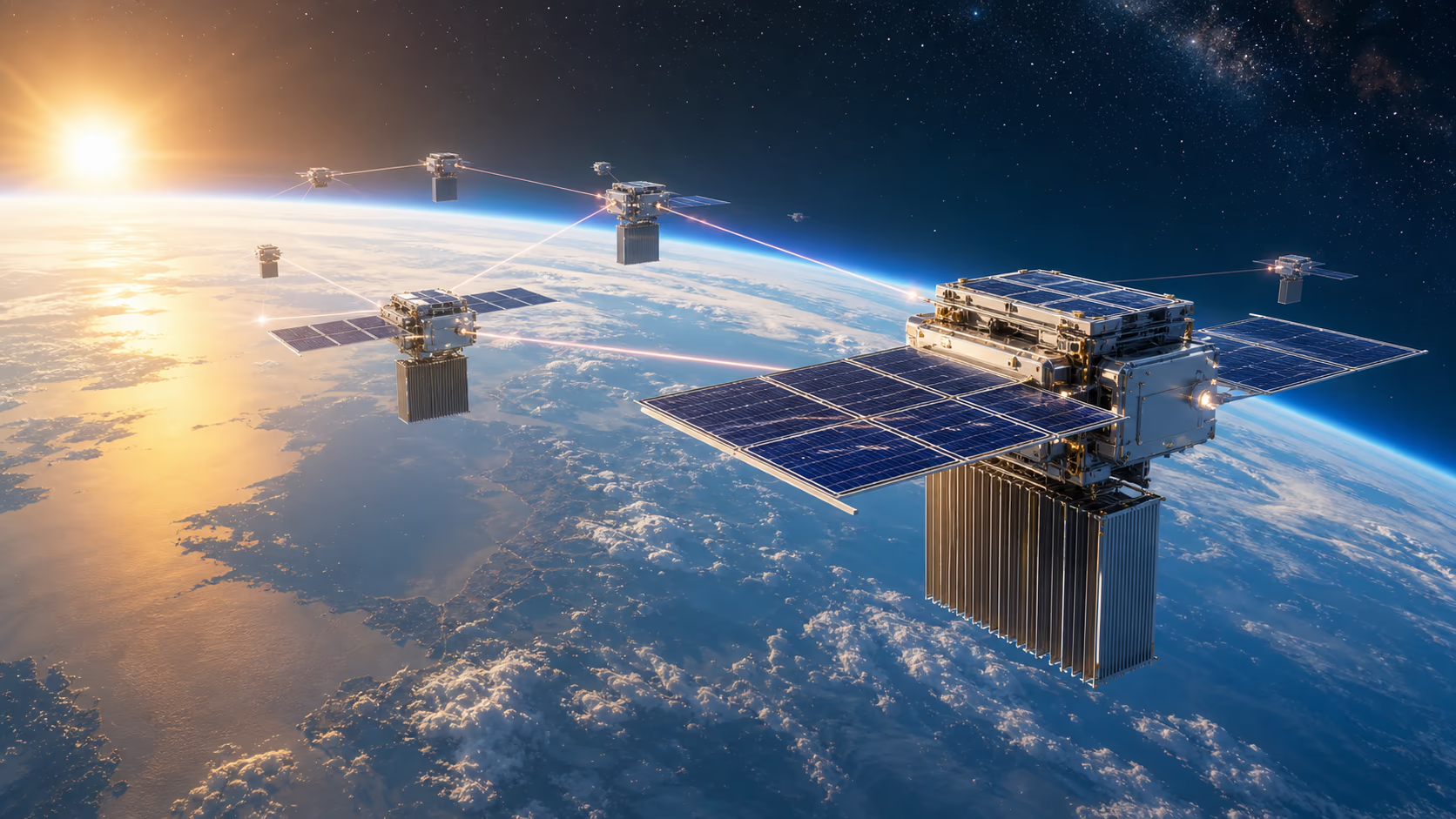
Google has published Project Suncatcher, a design for solar-powered TPU satellites connected by optical links, with a two-satellite prototype mission planned for early 2027. Starcloud says Starcloud-1 carried the first NVIDIA H100 GPU into orbit and became the first spacecraft to train an LLM, nanoGPT. SpaceX has reportedly described an orbital data center system that could scale toward up to a million satellites. Meta has reportedly reserved capacity from a space-solar startup to beam power down from geosynchronous orbit.
We have invented a machine so demanding that Earth itself is starting to feel like a constraint.
The proposed answer is not only to build another terrestrial data center.
It is to change the medium.
Move the compute into a place with near-continuous sunlight, no weather, no local water use, and a direct view of deep space.
That instinct is worth taking seriously. When a constraint becomes physical, we build a new physical system around it. This has always been one of humanity's stranger gifts: the refusal to treat the present operating environment as final.
But the philosophy only matters if the physics holds.
So let us build the thing on paper. Not the pitch deck version. The physical one. The sunlight, the bandwidth, the radiators, the speed of light, the launch cost, and the orbital commons that decide whether any of this is real.
The Load That No Longer Fits
AI is no longer just a software story.
It is chips, power, cooling, land, transmission, water, capital, and permits. The user sees a clean interface. Underneath it is an industrial system.
OpenAI's Stargate announcement framed the next phase openly: hundreds of billions of dollars for new AI infrastructure in the United States. xAI's Colossus project has already turned Memphis into a fight over turbines, local air quality, and the energy cost of frontier models; The Guardian reported that Colossus 1 was consuming about 150 megawatts, with a future facility projected at gigawatt scale.
This is the turn people still understate.
For decades, software scaled by becoming more abstract. The marginal cost of another user looked close to zero. The cloud made computation feel weightless.
AI reverses that illusion. The marginal token has a thermal shadow. The model runs on hardware that must be powered, cooled, housed, connected, depreciated, and defended against physics.
That is why the bottleneck is moving. It is no longer only algorithms. It is the raw capacity to deliver energy and remove heat. Data centers have become large, inflexible loads in grids that were not designed for training clusters to arrive like new cities.
One response is to build more power on Earth. Another is to make models smaller and more efficient. A third, more radical response is to move the furnace.
This is where orbit enters the story.
It is also where the show's running tension becomes concrete. Maxime Labonne's argument for local, private, edge AI pushes intelligence down onto the device, closer to the user. Orbital data centers push in the opposite direction. They are the maximal centralization thesis, literally elevated above the planet.
One future says intelligence should be small, private, and near the human.
The other says the next leap needs a machine large enough to chase the sun.
Why Orbit Is Tempting
The case for orbit is not vibes.
It begins with sunlight.
A satellite in a dawn-dusk sun-synchronous orbit can sit in near-continuous sun. No clouds. No atmosphere. No night in the ordinary terrestrial sense. Google estimates that, in the right orbit, a solar panel can be up to eight times more productive than the same panel on Earth.
That matters because terrestrial solar is cheap but intermittent. It needs land, transmission, storage, and a grid willing to absorb its timing. In orbit, sunlight becomes closer to baseload power.
The second advantage is location.
An orbital data center does not fight a town council for land. It does not draw from a local river. It does not ask a utility to thread a new gigawatt load through a regional grid. For an industry increasingly constrained by siting and power interconnection, those are not side benefits. They may be the point.
The third advantage is stranger: space looks like a place to dump heat.
Every watt into a chip becomes heat. A 1-gigawatt compute facility is also a 1-gigawatt heater. Put that on Earth and you move heat into air, water, chillers, cooling towers, and local climate arguments.
Put it in orbit and there is no air. No water. No convection.
That sounds like a benefit until you remember the trap: space is cold, but vacuum is a superb insulator. The only way to shed heat is radiation.
This is where the romance starts paying invoices.
Starcloud Makes The Bet Concrete
Starcloud's writing is useful because it says the quiet part plainly: orbital data centers are not a storage novelty or a poetic sustainability project. They are an attempt to make multi-gigawatt AI training clusters physically buildable.
In its white paper, Starcloud argues that a dawn-dusk sun-synchronous orbit can give a solar array a capacity factor above 95 percent, compared with about 24 percent for median terrestrial solar in the United States, with roughly 40 percent higher peak generation because there is no atmosphere in the way. The company claims the same array can produce more than five times the energy in orbit that it would produce on Earth.
That is the case for the sun.
The cooling case is subtler. Starcloud's blog calls space a place for "free radiative cooling", and that phrase is directionally right but technically dangerous if read too quickly. Deep space is an extraordinary heat sink. It is not a magic drain.
Starcloud's own white paper does the more honest work. It calculates that a radiator panel held around 20 degrees Celsius can net roughly 633 watts per square meter after accounting for sunlight and Earth's radiation. That is impressive. It is also not infinite. A gigawatt-scale data center still needs gigawatt-scale heat rejection, which means enormous radiator area, pumped thermal loops, deployable structures, pointing control, and mass.
This is why the title matters.
The sun never sets in the right orbit.
But cooling is finite.
Starcloud's roadmap also sharpens the workload question. Starcloud-2, its first commercial mission, is described as a GPU cluster with persistent storage, 24/7 access, and proprietary thermal and power systems in a smallsat form factor, intended to be operational in sun-synchronous orbit by 2027. The near-term use case is not "move the entire internet to space." It is in-space compute, secure storage, sovereign cloud, and high-volume analysis of spacecraft data that would otherwise have to be downlinked raw.
Space-native compute has a natural reason to exist: the data is already in space, the power is abundant there, and the latency penalty to Earth matters less if the processing happens before downlink. General-purpose AI training may come later, but the wedge is cleaner when the first customers are already orbital.
The Swarm Has To Think As One
Google's Project Suncatcher is useful because it is not merely a mood board. It is a worked system design.
The proposal is a constellation of smaller satellites, each carrying TPUs, solar arrays, optical links, and the thermal hardware needed to survive. The reference design describes an 81-satellite cluster at roughly 650 kilometers altitude, flying within a radius of about one kilometer.
That geometry is not decorative.
Training a large model requires many accelerators to share information constantly. In a terrestrial data center, that happens through high-bandwidth interconnects inside buildings where distance is measured in meters. In orbit, the chips sit on separate spacecraft. The machine can only train as one if the satellites can exchange data at enormous rates with low latency.
Google's design uses free-space optical links. Lasers, basically, between satellites.
That is elegant until distance enters. Once you pass the relevant optical limits, the received power falls with the square of distance. Double the gap and the received signal drops sharply. For data center-scale bandwidth, the satellites have to fly close together. Hundreds of meters apart, not casually distributed across the sky.
The result is almost beautiful.
The architecture is dictated by the equations. The satellites cluster because all-reduce demands it. They chase the dawn-dusk line because the sun demands it. They talk by light because cables are gone. They cannot drift too far apart because photons are unforgiving.
This is not one computer in the sky. It is a swarm trying to behave like one mind.
That makes the connection to Ramesh Raskar's Agent Zero thesis hard to miss, though it points in a different direction. Raskar's argument is that intelligence may arrive as a networked mesh of agents rather than one centralized "God model." Orbital compute borrows the mesh, but not the politics. It decentralizes the hardware in order to centralize the training run.
That distinction matters.
Networked architecture is not the same as distributed ownership.
What Belongs In Orbit
Not every workload belongs in space.
Training does. Or at least, training is the plausible first tenant.
A frontier training run is a long, batch-heavy process. Feed the model data. Move gradients. Synchronize accelerators. Run for weeks or months. Emit a model at the end. If a result takes tens of milliseconds longer to reach Earth, nobody waiting at a keyboard notices.
Inference is different.
Inference is the moment the model answers a human, agent, vehicle, factory, lab instrument, or financial system. It is latency-sensitive. The speed of light is generous until you start needing repeated round trips. Geostationary orbit is roughly 36,000 kilometers up; the round trip alone adds hundreds of milliseconds before processing, routing, and congestion.
So the honest architecture is not "the cloud moves to space."
It is division of labor.
Train in orbit where energy is abundant and latency barely matters. Infer near the user, the workflow, or the data. That is where Baris Gultekin's point about data gravity becomes load-bearing. Enterprises do not move sensitive operational data around for philosophical neatness. The AI has to come to the data when trust, governance, and context matter.
Orbit may be good for the furnace.
It is much less obviously good for the nervous system.
That distinction saves the idea from hype. It also narrows the business case. Space compute is not a universal cloud replacement. It is a candidate home for heavy, batch, power-dense work whose value clears the physics bill.
The Heat Does Not Disappear
The most humbling part of the whole design is cooling.
Space feels cold, but cold is a temperature. Cooling is a rate of heat removal.
On Earth, we move heat with matter. Air. Water. Coolant. Fans. Pumps. Towers. The details are complicated, but the principle is forgiving: move stuff, carry heat away.
In vacuum, there is no stuff.
The only way a satellite dumps heat is by radiating it away as infrared light. The Stefan-Boltzmann law says radiated power scales with area, emissivity, and the fourth power of absolute temperature. The fourth power is the gift and the curse. Very hot things radiate aggressively. Chips cannot run at furnace temperatures. They have to stay within survivable operating ranges.
So the bill comes due as area.
A serious orbital data center needs radiators: large surfaces whose job is to throw heat into darkness. Google is explicit that thermal management remains a major engineering challenge. The more power you run, the more radiator area, structure, mass, pointing control, and launch cost you carry.
That is the paradox.
Orbit gives you sunlight without weather.
It does not give you cooling for free.
The vacuum removes clouds and town councils. It also removes the atmosphere that made heat removal easy. The same environment that makes solar collection attractive makes thermal rejection brutal.
This is the first real test of orbital compute. Not whether a TPU can survive a prototype mission. Google's radiation tests on Trillium TPUs are encouraging. Not whether optical links can move bits; the bench demonstrator reached 1.6 terabits per second across a transceiver pair.
The test is whether the whole machine can run hot enough to matter and cool itself cheaply enough to survive the spreadsheet.
The Hinge Is Cost Per Kilogram
Every space dream eventually becomes a launch-cost argument.
The same is true here.
Google's analysis suggests that if launch costs to low Earth orbit fall below roughly $200 per kilogram by the mid-2030s, the operating cost of space-based compute could become comparable to the reported energy cost of a terrestrial data center on a per-kilowatt-year basis.
That sentence carries the whole bet.
Not "space compute is cheap." Not "orbital AI is inevitable." The claim is narrower and more honest: if launch costs fall far enough, and if the system can be integrated tightly enough, and if thermal management works, then the economics may stop being absurd.
That is a lot of if.
It is also not crazy. SpaceX changed launch economics once already. Reusability moved this conversation from science fiction to spreadsheet. If Starship or its successors drive the curve down again, entire classes of orbital infrastructure become thinkable.
But the sensitivity is savage. Move the cost per kilogram by a factor of three and the thesis changes. Add radiator mass, replacement cycles, station-keeping, collision avoidance, insurance, ground links, and orbital debris governance, and the clean comparison gets noisy fast.
This is why the right posture is neither dismissal nor awe.
It is engineering seriousness.
The physics does not obviously forbid orbital compute. That is new. The economics do not obviously bless it. That is the more important sentence.
This Does Not Stop At Compute
Once you accept the premise that orbit is useful because the sun never sets there, the idea quickly outgrows data centers.
If you can harvest continuous solar power in space, why spend it only on model training? Why not beam it down and power things on Earth?
That is the older space-based solar power dream, now pulled back into relevance by AI's infrastructure needs. Meta's reported reservation with Overview Energy points in that direction: collect sunlight in geosynchronous orbit, beam it down using near-infrared light, and pair it with long-duration storage on the ground.
The idea is physically plausible in pieces. Japan's space agency and Mitsubishi Heavy Industries have demonstrated kilowatt-scale microwave power beaming at ground-test distances. Rectennas can convert microwave energy into direct current. Lasers can reduce receiver footprint but struggle with clouds. Microwaves tolerate weather better but require vast apertures.
The problem is not magic.
The problem is scale.
A useful space-solar system has to collect huge areas of sunlight, convert it efficiently, point it safely, pass through the atmosphere, receive it on the ground, convert it again, and store it when demand does not match supply. Each step has losses. Each step has failure modes. Each step turns an elegant diagram into a civil engineering project.
That is why I would not make the essay about space solar yet.
It is the sequel. The orbital data center is the sharper object because it reveals the pattern first: AI is becoming a forcing function for off-world industrial infrastructure.
The machine needed power, and the sun was right there.
The Frontier Reflex
Step back from the equations and look at what they describe.
We are watching the oldest human reflex reassert itself.
When the field is spent, clear new land. When the harbor is crowded, cross the ocean. When the grid strains, look to orbit. The history of our species is partly a history of treating limits as problems of location, tools, and infrastructure.
That reflex is magnificent.
It is also dangerous.
The magnificent reading is real. Moving the heaviest industrial loads off Earth may one day be the most environmentally serious version of growth. Earth as garden, orbit as furnace. Life down here, industry out there. That is not a small vision.
It is not obviously wrong.
There is a mature version of abundance where we stop treating planetary limits as a reason to freeze civilization in place. We build more energy. We build better machines. We move the dirtiest work away from fragile ecosystems.
That is the best case.
The risk is also real.
Frontiers make bad accounting easy. They create the feeling of emptiness where there is only distance. They make shared environments look ownerless until the externalities arrive.
Move the machine to orbit and the bill changes form.
Space is not an empty spreadsheet. Low Earth orbit is already a shared, fragile commons. A million-satellite proposal is not merely a data center plan. It is a traffic-management plan, a debris-risk plan, an astronomy plan, an atmospheric reentry plan, and a governance plan.
Kessler syndrome is the dramatic version of the risk: a cascading debris field that makes useful orbits harder or impossible to use. But the quieter version matters too. Who gets to occupy orbit? Who pays when the commons is damaged? Who decides whether AI training is worth the orbital congestion?
These are not anti-technology questions.
They are ownership questions.
The Orbital Commons Test
The question is not whether orbital compute should be rejected.
That is too easy.
The better question is what standard it has to clear.
I think the answer is an orbital commons test.
First, the workload has to belong there. If the job is latency-sensitive, tightly coupled to private data, or better solved through model efficiency, edge inference, or terrestrial energy improvements, orbit is probably vanity.
Second, the energy gain has to survive full accounting. Launch, replacement, radiators, ground stations, debris mitigation, embodied emissions, reentry effects, and governance cannot be externalities hiding outside the spreadsheet.
Third, the orbital risk has to be priced as a commons risk, not a private operational cost. A company can absorb a failed satellite. Civilization absorbs a damaged orbital environment.
Fourth, the purpose has to be explicit. "The model is bigger" is not enough. We should ask what kind of intelligence the infrastructure creates, who owns it, who benefits from it, and whether it advances abundance in the human sense rather than merely industrial scale.
That is where Stephen Wolfram's conversation keeps echoing for me. The space of possible computation is enormous. We have barely touched it. The question is not only whether we can pour more energy into exploring it. It is whether the next sliver of the possible is worth a power plant in the sky.
That is the standard.
Build, but make the bill visible.
Explore, but do not let distance launder cost.
Use orbit where the physics, economics, and purpose all clear the bar. Do not industrialize the sky with terrestrial externalities merely moved above the atmosphere.
The Choice No One Is Making
The strangest part is that no one decides this all at once.
No one sits down and declares: let us industrialize the heavens for machine intelligence.
It happens as a chain of locally reasonable decisions. The grid is strained, so look for power elsewhere. The chips survive radiation, so launch the prototype. The optical link works, so add more nodes. Launch gets cheaper, so scale the constellation. The sun is constant, so beam it down.
Each link is sensible.
The chain carries us somewhere no one explicitly chose to go.
That is how the largest transformations usually happen. Not by one grand vote, but by accumulation. One infrastructure decision at a time. One procurement cycle. One mission. One filing. One more model that needs one more order of magnitude.
Maybe a thousand years from now this looks obvious. A planetary species began, awkwardly and imperfectly, to become a stellar one because its machines needed power.
Maybe the orbital data center becomes one of the cathedrals of our age: a structure that reveals what we worshipped by what we were willing to build.
But we owe ourselves one honest sentence before we light the rockets.
The sun never sets in orbit.
Neither does the heat.
The frontier is real. The math is real. The opportunity may be real. But abundance only deserves the name if the bill is visible, the commons is protected, and the intelligence we create is worth the infrastructure required to run it.
The Masters question has never been whether intelligence gets bigger. It is whether intelligence becomes more useful, more owned, and more human. Subscribe for the next essay in the series.
all signal, no spam.